The Clock of the Long Now
A monument scale mechanical clock, built inside a mountain, designed to keep accurate time for the next ten millennia.
Summary
The Clock is hundreds of feet tall, engineered to require minimal maintenance, and powered by mechanical energy harvested from sunlight as well as the people that visit it.
The Clock will mark time with astronomic and calendric displays and a chime generator designed with the help of Brian Eno that can produce over 3.5 million unique bell chime sequences — one for every day the Clock is visited for the next 10,000 years.
Ten thousand years is about the age of modern civilization, so The Clock will measure out a future of civilization equal to its past. This assumes our civilization is in the middle of whatever journey we are on — an implicit statement of optimism.
To see The Clock you need to start at dawn, like any pilgrimage. It will require a day’s hike to reach its interior gears.
It is still being assembled, deep inside a mountain, in West Texas.
Why build a giant clock?
The Clock provides a rare invitation to think and engineer at the timescale of civilization. It offers an enduring symbol of our personal connection to the distant future.
Motivations
Why would anyone build a Clock inside a mountain with the hope that it will ring for 10,000 years?
Part of the answer: just so people will ask this question, and having asked it, prompt themselves to conjure with notions of generations and millennia. If you have a Clock ticking for 10,000 years what kinds of generational-scale questions and projects will it suggest? If a Clock can keep going for ten millennia, shouldn’t we make sure our civilization does as well? If The Clock keeps going after we are personally long dead, why not attempt other projects that require future generations to finish?
The larger question is, as virologist Jonas Salk once asked, “Are we being good ancestors?”
Ten thousand years — the life span I hope for The Clock — is about as long as the history of human technology. We have fragments of pots that old. Geologically, it's a blink of an eye. When you start thinking about building something that lasts that long, the real problem is not decay and corrosion, or even the power source. The real problem is people. If something becomes unimportant to people, it gets scrapped for parts; if it becomes important, it turns into a symbol and must eventually be destroyed. The only way to survive over the long run is to be made of materials large and worthless, like Stonehenge and the Pyramids, or to become lost.
Just as Stonehenge and the Pyramids help us imagine our long past, The Clock invites us to image our long future.
Ten thousand years from now: can you imagine that day? Okay, but do you? Do you believe “the Future” is going to happen? If The Clock works the way that it’s supposed to do — if it lasts — do you believe there will be a human being around to witness, let alone mourn its passing, to appreciate its accomplishment, its faithfulness, its immense antiquity? What about five thousand years from now, or even five hundred?
Can you extend the horizon of your expectations for our world, for our complex of civilizations and cultures, beyond the lifetime of your own children, of the next two or three generations?
Civilization is revving itself into a pathologically short attention span. The trend might be coming from the acceleration of technology, the short-horizon perspective of market-driven economics, the next-election perspective of democracies, or the distractions of personal multi-tasking. All are on the increase. Some sort of balancing corrective to the short-sightedness is needed — some mechanism or myth which encourages the long view and the taking of long-term responsibility, where 'long-term' is measured at least in centuries.
The Clock presents both mechanism and myth.
It would be charismatic to visit, interesting to think about, and famous enough to become iconic in the public discourse. Ideally, it would do for thinking about time what the photographs of Earth from space have done for thinking about the environment. Such icons reframe the way people think.

I cannot imagine the future, but I care about it. I know I am a part of a story that starts long before I can remember and continues long beyond when anyone will remember me. I sense that I am alive at a time of important change, and I feel a responsibility to make sure that the change comes out well. I plant my acorns knowing that I will never live to harvest the oaks.
- Clock in the Mountain by Kevin Kelly
- The Millennium Clock by Danny Hillis
- The Future WIll Have to Wait by Michael Chabon
- The Clock of the Long Now by Stewart Brand
How do you build a clock that will tick for 10,000 years?
It’s one thing for a monument to endure for ten millennia, but The Clock also has to keep accurate time.
Design & Construction
Over ten thousand years, performing even the most basic functions of a clock: gathering energy, keeping time, and converting it into a meaningful display, becomes interestingly complex. As The Clock’s inventor Danny Hillis considered each of these functions, a set of design principles emerged which are generally useful to consider when designing anything to last a long time:
Longevity
The Clock should display the correct time for the next 10,000 years.
Longevity principles —
- Go slow
- Minimize sliding friction
- Stay clean and dry
- Expect bad weather and earthquakes
- Expect non-malicious human interaction
- Don’t tempt thieves
Maintainability
It should be possible to maintain The Clock with little maintenance, using bronze-age technology.
Maintainability principles —
- Use familiar materials
- Make it easy to build parts
- Include the manual
Transparency
It should be possible to determine the operational principles of The Clock with close inspection.
Transparency principles —
- Allow inspection
- Allow rehearsed motions
- Expect restarts
Evolvability
It should be possible to improve The Clock over time.
Evolvability principles —
- Separate functions
- Provide simple interfaces
Scalability
It should be possible to build working models of The Clock from table top to monumental size using the same design.
Scalability principles —
- Make all parts similar size
You will see all these principles reflected throughout the design of The Clock.

The Mechanism
The Clock is entirely mechanical, made of long-lasting materials, including titanium, ceramics, quartz, sapphire, and 316 stainless steel. Even the most accurate mechanical clocks eventually drift off of the correct time, so The Clock synchronizes with the noontime sun. The Clock counts oscillations of the pendulum for day to day time, sunlight falling on the solar synchronizer to account for long-term drift, and a precomputed correction to solar time to accommodate for the orbital and rotational changes of Earth (rendered by the iconic Equation of Time Cam). Outputs include a depiction of the sky in the form of an orrery, a display of the Gregorian calendar date, and the chimes. Here’s how the pieces come together:
Solar synchronizer
Sunlight enters the mountain through a south facing synthetic sapphire window, heating up a chamber of air, which moves a graphite cylinder. This movement synchronizes the timing system to solar noon, critical for maintaining long-term timekeeping accuracy. It also provides enough winding force to keep the pendulum ticking without human intervention.
Timing system & displays
Energy from the solar synchronizer above or the power system below is fed into an escapement that powers a slow moving titanium pendulum. This timing system is kept from drifting by corrections from the solar synchronizer and the Equation of Time Cam. The timing system is connected to a series of displays made up of dials and mechanical calendars. Visitors wind a wheel to advance the dials, which stops when it reaches the present moment. The Clock always knows what time it is, but only shows you when you wind it.
Chime generator & chimes
The chime generator is a mechanical computer that rings ten bells in a different order each day someone winds The Clock for 10,000 years. The generator is made up of a cascading series of Geneva wheels which create intermittent motion (a bell ring) out of continuous rotation (from the power system). When the chimes are ringing, a geared speed governor spins up and moderates energy coming out of the power system.
Power system & clock winder
The main winder is made up of an enormous capstan that visitors can spin to wind The Clock. Both the main winder and the solar winder store power in a large weight hanging from a rack gear. The power from this system is used to power the Clock and ring the chimes on any day that The Clock is fully wound. The rest of the time, any energy remaining after powering the time-keeping mechanism is stored, ensuring that The Clock can run for many years without sunlight or human winding.
The Journey
A visit to The Clock begins several hours before you reach the main winder. Just reaching the entrance tunnel, situated 1,500 feet above the high scrub desert, will leave some visitors out of breath, nicked by thorns, and wondering what they got themselves into. Once you enter the underground space , you will eventually encounter a set of metal doors. These act as a kind of crude airlock, keeping out dust and wild animals. Once through the doors you head into the darkness of a long tunnel. At the end, there’s the mildest hint of light ahead that you slowly find your way to. You look up. There is a faint light filtering down to you through giant gears illuminating the beginning of a spiral staircase.
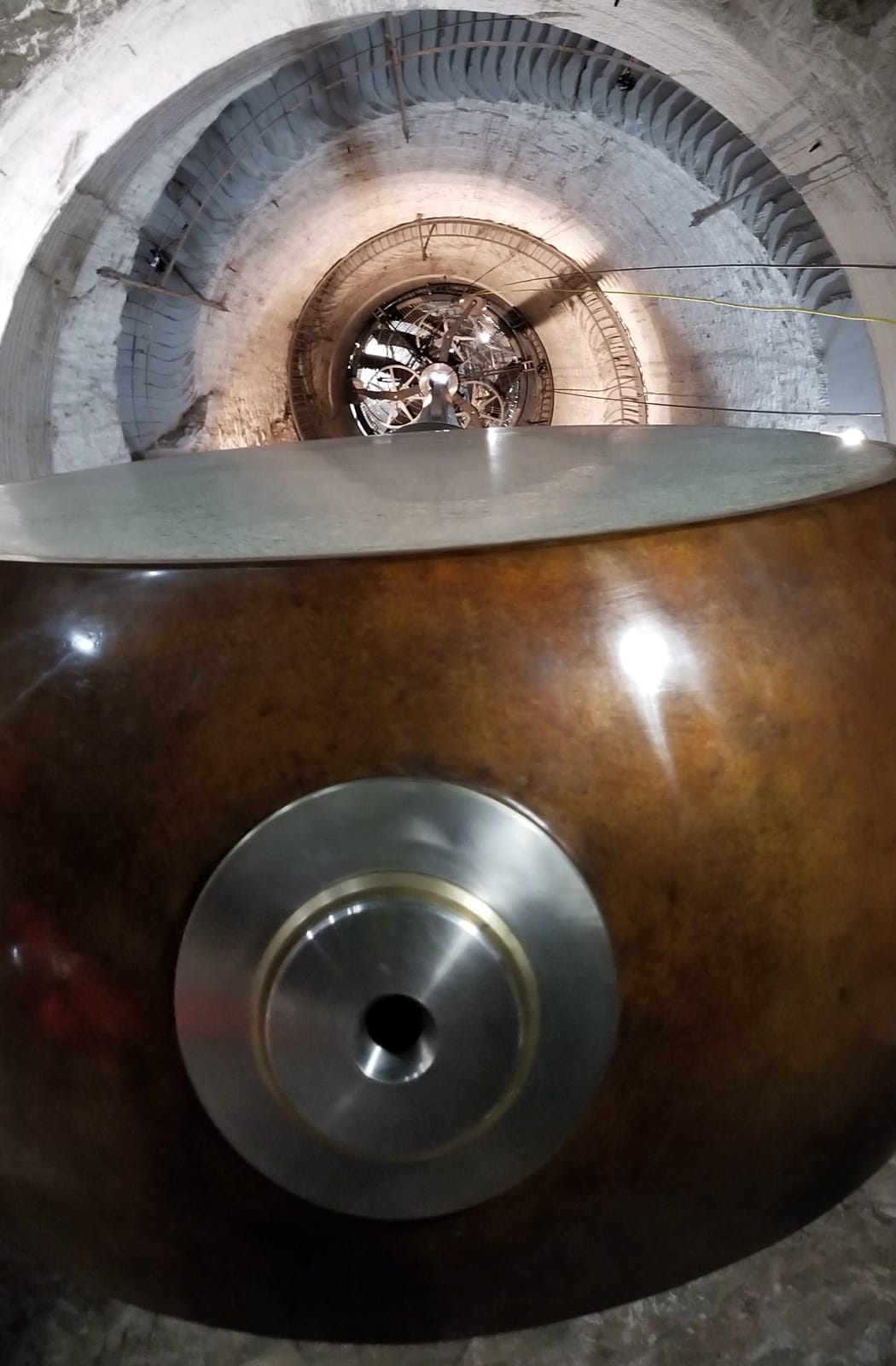
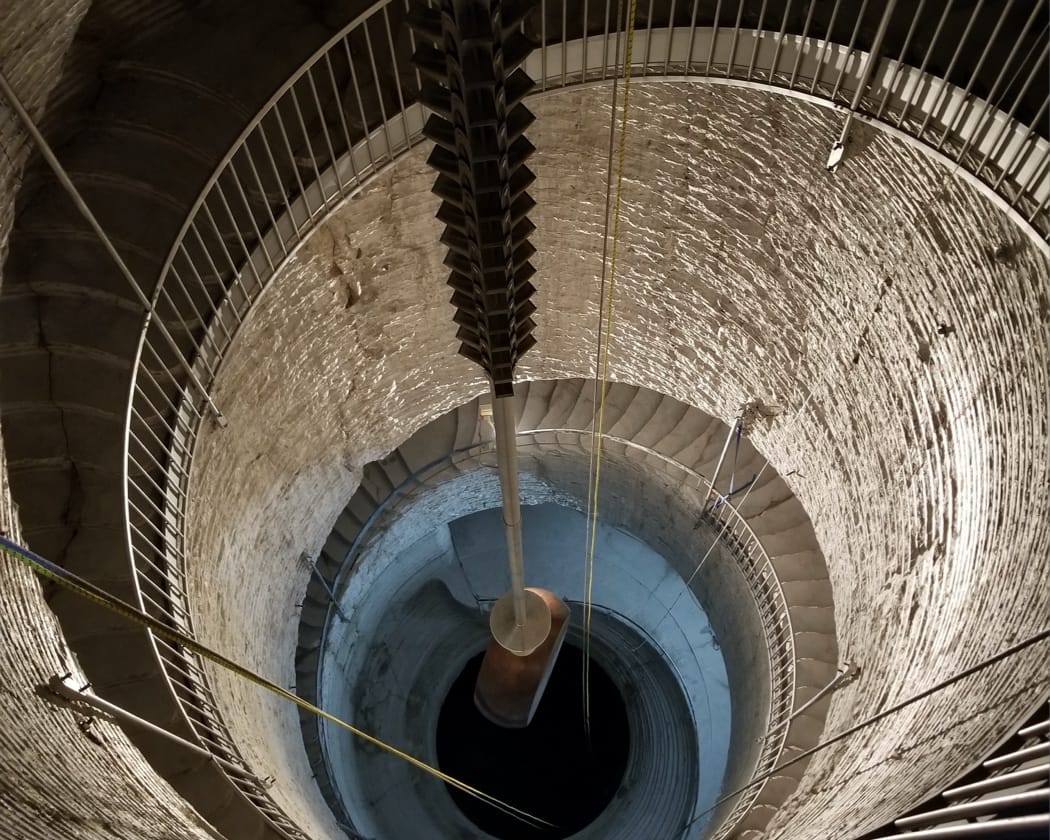
You start climbing the staircase, winding up the outer rim of the tunnel, rising toward the gears and faint light overhead. The stairs are carved out of the rock. To cut the spiral staircase, a special stone cutting robot was invented, which crept downward from the top of the shaft, grinding out a few stairs per day for nearly two years. After climbing about 100 feet, the first clock part you encounter is the driveweight of The Clock’s power system. This is a large bronze egg filled with concrete, about the size of a small car, and weighing 10,000 pounds.
After you pass the weights, you arrive at a winding station. It is a horizontal windlass or capstan, like one that might raise the anchor of an old sailing ship. It takes two or three visitors to turn the capstan easily and slowly lift its 10,000-pound weight. Together you spin the winder until the weight reaches the top of its travel beneath your feet.
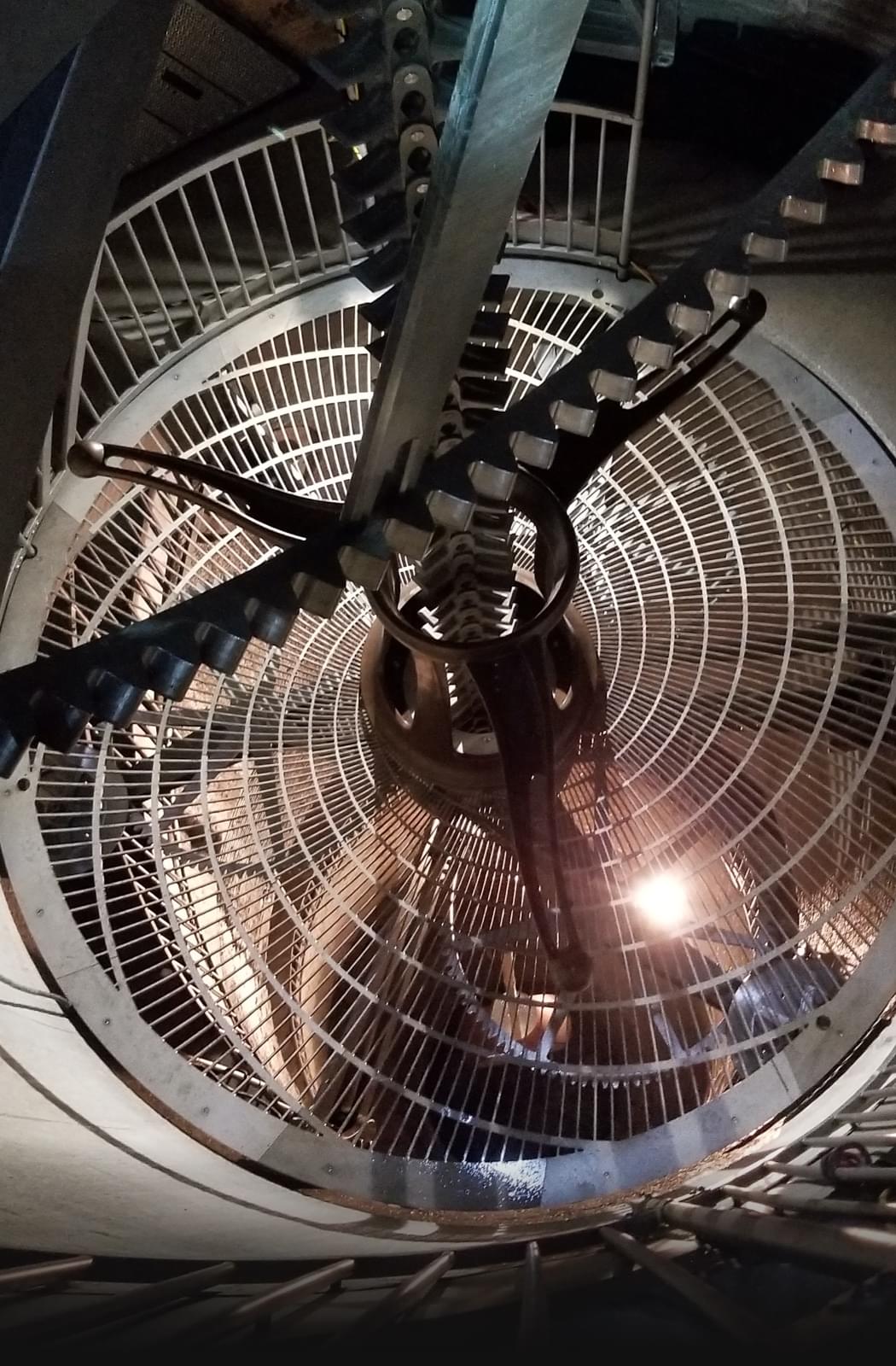
You keep climbing, past a multitude of giant gears, some over 8 feet in diameter and weighing 1,000 pounds. And past those you start to see large Geneva wheels that form the chime generator. This mechanical computer uses a progressive algorithm to determine which of the millions of possible sequences the chimes will play on a given day. The chimes will not repeat for over 10,000 years. This is the world’s slowest computer.
On days when visitors are there to wind it, the calculated sequence rings each of the ten bells.


Fellow traveler and musician Brian Eno named the organization The Long Now Foundation to indicate the expanded sense of time The Clock provokes — not the short now of next quarter, next week, or the next five minutes, but the “long now” of centuries. Eno also worked with Danny Hillis on the chime generator’s progressive algorithm. His album, January 07003: Bell Studies for The Clock of the Long Now, provides a preview of the chimes that will ring inside the mountain over the millenia.
Changes for January 07003, Soft Bells, Hillis Algorithm
Brian Eno
“When we started thinking about The Clock, we naturally wondered what kind of sound it could make to announce the passage of time. I had nurtured an interest in bells for many years, and this seemed like a good alibi for taking it a bit deeper.”
The Clock always knows the correct time, but to save energy, it won’t update its display dials unless a visitor is present to provide the necessary power. Another hand-turned wheel awaits your effort. This one winds more easily — moving display dials requires less power than ringing bells. As you wind, the calendar wheels whirr until it stops and it shows the current date and orientation to the heavens.


The timing system sits at the center of the chamber. The pendulum and escapement are encased in a shield of brass and quartz glass to keep out dust, air movements, and critters. The pendulum, which governs the timing of The Clock, is a 6-foot long titanium assembly terminating with football-sized titanium weights. It swings at a satisfyingly slow 7-second period. The slight clicks of its escapement can just be heard in the silence of the mountain.
So how does The Clock keep going if no one visits it for months, or years, or perhaps decades to wind it? A pathway continues up to the outside summit of the mountain and you can see the answer. That faint light seen from the bottom has resolved into a 12 foot cupola with a sapphire glass window covering the top of the shaft. This and a partially buried cylinder are the only parts of the clock visible from the outside. Sunlight enters the cupola and is focused down into the solar synchronizer, heating up a chamber of air which can be harvested as a mechanical signal for solar noon. This signal is adjusted by the Equation of Time Cam, which accounts for the +/- 15 minute difference of solar-to-absolute-time due to the eccentricity of the Earth's orbit (and a few other slow effects like the precessional cycle and rotational speed).


Thermal power has been used for small mantel clocks before, but it has not been done before at this scale. As long as the sun shines and night comes, The Clock can keep time by itself, but it can’t ring its chimes for long or show the time it knows without visitors.
There is more than just technology in the mountain. The ticks of time are a very human invention. Astronomical calendars are among the first relics of culture, and often the mark of civilizations. The Clock in the mountain not only plays the music of an ever-changing slow melody, but it will collect cultural expressions of time, ticks to mark the passage of decades and centuries. Off to the side of the main cavern of The Clock are a series of small niches to explore and collect these notices of time. Their contents will be a surprise.
The journey to The Clock in the mountain ends on the summit in light. It is the sun that powers its ringing below. Like a heart beating while we sleep, The Clock in the mountain keeps time even when we pretend the past did not happen and the future will not come.
The Challenge
Almost any kind of artifact can last 10 millennia if stored and cared for properly. We have examples of 5,000-year-old wood staves, papyrus, and leather sandals. On the other hand, modern metal can corrode in a few years of salt and rain. For longevity, the environment is often more important than material. The mountain top in Texas is a high dry desert, and in The Clock shaft below, the temperature is a stable 55 degrees fahrenheit regardless of time or season. This avoids freeze and thaw cycles, which can be as corrosive as water. It’s an ideal world for a ceaseless Clock.
Still, The Clock is a machine with moving parts, and parts wear down and lubricants evaporate or corrode. Most of The Clock will be made in a marine grade 316 stainless steel. One of the main worries of the Clockmakers is that elements of a 10,000 year Clock — by definition — will move slowly. The millennial dial creeps so slowly it can be said to not move at all during your lifetime. Metals in contact with each other over those time scales can fuse — defeating the whole purpose of an ongoing timepiece. Dissimilar metals in contact can eat each other in galvanic corrosion. To counteract these tendencies, all of The Clock’s bearings are ceramic.
Ceramics will outlast most metals as they can be diamond hard and do not corrode or rust. We have found shards of clay pots over 17,000 years old. Because these engineered ceramic bearings are so hard, and rotate at very low speed, they require no grit-attracting lubrication.
The biggest problem for the beating Clock will be the effects of its human visitors. Over the span of centuries, valuable stuff of any type tends to be stolen, kids climb everywhere, and hackers naturally try to see how things work or break. But it is humans that keep The Clock’s bells wound up, and humans who ask it the time. The Clock needs us. It will be a long, out of the way journey to get inside The Clock ringing inside a mountain. But as long as The Clock ticks, it keeps asking us, in whispers of buried bells, “Are we being good ancestors?”
Join now
Starting at $8/month
Will you take your turn at the winder?
No completion date is set, but members of The Long Now Foundation will be among the first invited to this monumental experience of deep time.
Stay Informed
Join now
Starting at $8/month
Once you hold these longer timeframes in mind, you start to raise the question of what you do on Monday.
Does your behavior start to reflect this larger frame?
Clock Team
Danny Hillis
DESIGNER & FOUNDER
Alexander Rose
PROJECT DESIGN
Marisa McKay
PROJECT MANAGER
Jascha Little
LEAD ENGINEER
CLOCK BUILDERS
Zoe Stephenson
Luke Khanlian
Brian Roe
Chris Rand
Dave Miner
Brian Ford
Dimitar Vassilev
Jake Faw
Sandy Curth
Robbie Bennett
Pete Abrahamson
RIGGING
Sean Riley
Dave Frietag
UNDERGROUND, STONE & SITE WORK
Jacobs & Associates
Stuart Kendall & Jason Clauson
Arron Griffith
Glen Ragsdale Underground Associates
ALUMNI AND ADVISING ENGINEERS
Stewart Dickson
Kiersten Muenchinger
Paolo Salvagione
Liz Woods
Kevin Cordell
Greg Baiden
Dr. Anton Hasell
PARTNERS AND SPONSORS
Autodesk
California Surveying & Drafting Supply, Inc.
G. Ragsdale & Assoc.
General Polygon Inc.
Geomagic Inc.
Granta Design Ltd
KUKA Robotics
LA CNC Inc
LMI Aerospace Inc
Machinists Inc.
Optica 3
Penguin ASI
PTC Pro Engineer
Rayotek
Seattle Solstice
Seneca Group
Swaggart Brothers Inc.
US Cementation
VirtuaLabs
Visible Gravity
In 02024, Danny Hillis answered frequently asked questions about The Clock.
In 02022, the bells of The Clock pealed for the first time. This footage is from the new documentary We Are As Gods, which explores the many legacies of Long Now co-founder Stewart Brand.
In 02018, with underground excavation complete, the first enormous timekeeping components were assembled underground, including the drive weight, winder and main gearing.
Long Now's website is changing...